Google Tag

banner

Showing posts with label Paddle shit. Show all posts

Friday, March 3, 2017

Bucket Seat: Lexus IS200t


When it comes to luxury car makers, the D Segment is by far their most popular range. Many term this their "bread and butter", as these models tend to be the perfect entry level car among prospective buyers. It's affordable and the with the seemingly endless options, it can extend from a basic model right up to high end one that rival cars in the segments above. The competition has always been a tough one and most of the time, the German trio seem to have the biggest say if one has to look at the sales over the years but what if the alternatives were better? Step in Lexus, Toyota's luxury division, whilst many associate the brand for being "boring", purely because of one egocentric television presenter, I think the brand is anything but.


Ever since Lexus brought the IS range into the country, they kept things plain and simple with just two models at the time, the IS200S and the IS200SE, with both cars offering the end buyer a host of  features, most of which would be deemed extras in the German contenders, and we all know how much extras amount to in them.  Fast forward to today and not much has changed, the new revised Lexus IS range that has just hit the country offers three variants, the IS200t E, IS200t EX and the IS350 F-Sport. I first caught a glimpse of the revised IS at last years SA Festival of Motoring in Kyalami and was taken away by the car, I had the opportunity to spend a week with the IS200t E and can't say it was easy letting go of the key when I had to return it.


STYLE

While previous IS models were good looking, there was a subtle nature to their design, with clean lines, nothing over the top but still maintain that elegance it deserved. I'm not sure if the designers at Lexus ate too much wasabi or had a few extra shots of Saki when they went into designing this one because it's completely different to what we would normally expect from the Japanese manufacturer. Lexus call it their "L Finesse design language", I just call it shockingly stunning. I say shockingly because there is nothing cautious or "boring" about it. Everything about the cars design philosophy needs to be admired, from the spindle grille, the split front headlamps, the sharp and edgy lines cutting its way across the car to the back , where this is continued with the rear lights that slice it's way into the bumper. It's all finished off well with a dark grey 17" alloy wheels with option for bigger ones if you want. It's drastic, its in your face and I love it! It's eye catching but not something that will hurt you eyes but rather something that you'd stare at while sitting in your car and make you wish your car looked half as good as it. It almost reminds me of a samurai warrior for some reason, sharp, agile and quick and that's just going on looks.


COMFORT

While I could go on about the exterior, the interior deserves some talking about as well. For me, the driver is the most important person in the car and very few cars give that feeling, with the IS it is very evident. It has a very driver focused cockpit with everything within's arm reach of you, it is the only place you'd want to sit in the car...actually I don't think I sat in any other seat in my time with it but I have it on good authority that the back seats are quite comfortable and spacious from the many people that I have given a ride to in the week. The finishes and materials used in the car are all high end and of great quality, and it's all done at their award winning Tahara plant. I mean the place it's being made in has won awards so you know you're product is going to be of high quality. It's the simple things that win you over in the car, if you follow me on Snapchat, you would have saw me mention how great the steering wheel feels, seriously do yourselves a favour and go find a Lexus IS and feel the how awesome the steering wheel feels. I'd suggest you go to a showroom as asking an owner might seem a bit creepy. The ride quality on the car is great, with it having double wishbone suspension upfront and multi-link at the back this ensures a smooth ride. There is little to no engine noise in the cabin and with dual zone climate control, the temperature can be set to suit everyone's needs. I also love the controls for them, as you just run your finger up or down the lengthy control. The car also comes with heating and cooling seats, which prove to be a winner in Durban with the extreme heat and humidity.  


PERFORMANCE

Its the first time Lexus has added a turbo engine to its local line up, and it's about time they did with the other manufacturers taking advantage of this over the years. The engine is a 2.0 litre, 4 cylinder, inline arrangement with D-4ST (Direct injection 4-stroke) with a maximum power output of 180kW @ 5800rpm, pushing out 350Nm of torque. The car has three driver settings, Eco, Normal and Sport, driving around urban areas, the Eco mode shines through, with low fuel usage, power when you need it with an extremely quiet and gentle ride, almost as if you're floating around. The Normal mode gives you slightly higher revs and quicker reaction time but at times it also switches automatically to Eco mode when the car feels it could use less power than actually needs, a great feature to help you save fuel. There is a slight turbo lag if you want to get off a standing start quickly but that is reduced quite a bit when flicked over into sport mode, naturally this makes the car very thirsty so just watch your foot. It's so much fun though, slap the gear selector into manual mode, and take charge of the gear changes with the paddle shifts behind the steering wheel and it will make you feel like a race car driver. Once going in any mode, the car picks up pace very quickly so you got to keep and eye on the counter. All in all, this engine packs quite punch but at the same time is the perfect all rounder for a car like this. 


TECH

Like I said, Lexus is known to have most features that other manufacturers would deem optional extras as standard in their models. As previously mentioned, the IS has heated and cooling seats, standard, as well as dual zone climate control, standard. Advanced energy saving LED headlamps, standard, 8-way electrically adjustable seats with driver lumbar support, standard and the list goes on though there were a few things that I thought the they could have included as standard feature which were missing. PDC's is one of them, with most cars these days, its almost becoming essential and with the design of the car, its not that easy to judge how far away you are from objects, so even if I'm pushing it, a reverse camera? Most Corolla's have that as a standard feature now so you'd think it would be in a Lexus. Anyway, that is about the only low point I have with the car. The standard sound system the car comes with is impressive as well, a 10 speaker audio system with full iPod integration and 2 USB ports with an added auxiliary port. The IS also comes with Bluetooth telephone and audio streaming so there really isn't a need for all the wires. 


VERDICT

Everything about the brand is personified by it's slogan, "The pursuit of perfection" and it shines through in their products. This model is a revised version of the IS but to show you how they focus on not just improving their product but the intricacies they go through to make it perfect is mind blowing, here's an excerpt from the brochure "we've moved the driver's seat hip point backwards by 18mm and lowered it by 9mm, and raised the steering wheel pitch by 3 degrees" . Millimeters, that is the level of detail they go to, to ensure the product they send out is perfect in their eyes and it's something that I admire about Lexus. Whilst the cars price range is a bit more than its competitors, one must remember what you're getting in the IS200t E as apposed to the others, for me personally, I think this is the best all round purchase for the D Segment category and a complete package if I may call it that.


SPECIFICATIONS


 Engine
 2.0 litre, 4 Cylinder
 Gear Box
 8 speed automatic with paddle shift
 Power
 180kW
 Torque
 350Nm
 Top Speed
 230km/h
 0-100km
 7.0 seconds
 Price
 R601 900* 

*Base price.


Friday, September 16, 2016

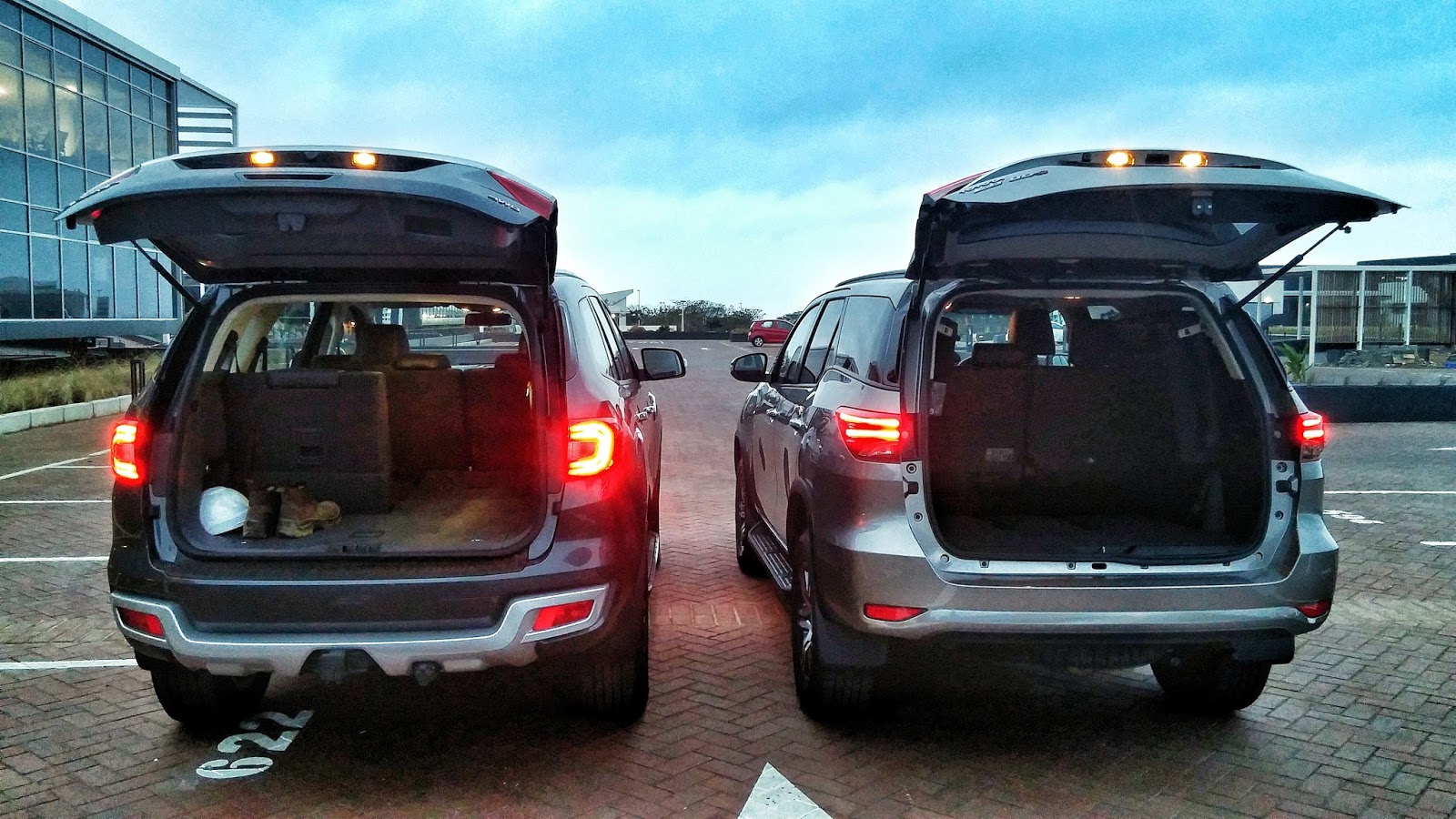
Bucket Seat: Ford Everest vs Toyota Fortuner


The Ford Everest and the Toyota Fortuner are currently the two most popular SUV's currently on the market without a shadow of a doubt. Both in direct competition with each other offer people in the segment a good variety of options to make their decision on which one to get. Which one is better though? I know it's tricky question seeing that it depends on individual preference but having driven both in the space of two weeks I did find some high points and low points to both and in this post I'll be highlighting them and giving my verdict on which I felt was the better of the two. 


Style
In this department I can't fault either of them, both sets of designers did an amazing job for the respective vehicles. Ford has taken roots from it's American side in and beefed up the latest Everest. It's a great design, bold and masculine. Harnessing the age old Ford Slogan "Built Ford Tough". Like I mentioned in my review of the SUV. It's a complete design with no loose ends. The lines flow perfectly and tie up lovely in the back. 

Toyota on the other hand went from a fairly Conservative design in the original Fortuner and added a bottle of Saki to it. It's a radical makeover and one which I feel was needed. We were seeing too many boring designs coming out of Japan and with a popular SUV like the Fortuner, it needed something different, something edgy and that's exactly what we got. Lots of design queues from the Lexus line of the company but I'm not complaining, as mentioned in the review, it won't be everyones cup of tea but sales will be the ultimate test and so far it seems to be passing. 


Performance
While both SUV's had different power plants, they were similar enough to compare. The Everest came with Ford's 3.2 litre, 5 cylinder, TDCi engine whilst the Fortuner had a slightly smaller 2.8 GD Hi engine. Both diesel engines, with the Ford's egding it in capacity and so most of the figures as well with it having 13 more torques and 20 more kW but while the figures say one thing, it might not generally mean that the one with the higher figures is the winner. While the Everest did have more torque, I found it to be very sluggish on take off or on lower gears, with lots of tubro lag and I think the general weight of the SUV slowing it down a bit. The Fortuner however had no such issues, even with it being in Eco mode which has lower revs, it still managed to take off faster which is evident in the 0-100km times. The Ford managing this in 11.6 seconds while the Toyota chops off almost a second off that time in 10.8 seconds. 

Both SUV's came with a 6 speed automatic gearbox with manual shift options, however again with this I felt the Ford's gearbox to be a bit lethargic and slow to think while the Toyota's gear box was a bit to quick. For example while going down a hill and not pressing the accelerator, the Toyota for some reason would down change and have a high rev all the way until you pressed the peddle again. I found this really odd and annoying at times. The Ford's gear box took a bit of time to think whether it needs to change gear or not, again forcing the revs high. The one thing I did like is that the Fortuner came with paddle shifts. Now I know what you're thinking, paddle shifts on an "SUV?!" But trust me it works like a beaut! 


Comfort
I'm bigger than your average guy so I appreciate spacious cars and both of these SUV's are extremely spacious. They are both 7 seaters and can seat seven adults comfortably. While there is plenty of space, are the seats comfortable tough? With the Ford, yes they were comfortable and it did come with leather seats but I found the quality of the leather to be a bit cheap, it gave that very slippery feel to it and just looked dull. Maybe it was the grey colour but I was not impressed. 

The Fortuner though, I couldn't stop raving about the leather in this car. From the seats to the leather that was used to cover the dash board, it felt amazing to touch and even better to sit on. The Toyota did come with a few creature comforts that were non existent in the Everest, like electronic front seats while the Everest was manual but the ride quality in the Everest seemed to have shaved the Toyota's as what let it down was the engine noise in the cabin. 


Tech
This one surprised me, having owned Toyota's for most of my life I know they were not ones to embrace technology like the rest of the manufacturers but I think they had more to offer in the Fortuner than what the Everest had. To start off with, keyless entry for the Toyota with a push button start, the Everest? Normal key, very boring. As mentioned before, the Toyota front seats are electronic, the Everest? Manual. Both Instrument clusters had a display to it but I think the Everest's layout was better and while it did seem complicated to work at first, it was pretty easy with the steering wheel controls to figure out what you wanted displayed and where, the overall layout looked better with the large cylindrical rev counter with the two digital displays either side of it. 

The touch screen in the Ford was better and slightly bigger compared to the Toyota, also it had more to offer. The Toyota also lacked PDC's, which I found extremely odd for such a big vehicle. Both SUV's offered blue-tooth phone and audio streaming with effortless syncing and usage. The sound system on the Everest was clearly better than the Fortuner. Not sure if you get to upgrade the sound package in the options list on the Toyota's but it would be great if they did. Both SUV's lacked Satellite Navigation, which for a 4x4 should be standard and a waste of those big touch screens. On the head lights, Toyota came with Hi Beam LED's whilst the Everest had your normal headlamps if yesteryear. 


Storage
Both vehicles offer more or less the same volume of storage with the Toyota edging it by have it's spare wheel under the car as apposed to the Everest having the spare wheel in the boot. However, Toyota's fold up back seats do take up more space and does hamper the capacity a bit. As mentioned in the respective reviews, if all 7 seats are in use, it does reduce luggage capacity tremendously. 


Offroad
Although you would find 90% of these SUV's on the road for most of their lifespan, make no mistake, when you take either of them off road, they both can handle their own. The Everest easy terrain selection is a wonderful addition which is simple enough for any novice to understand and operate. Choose your type of terrain and the car does the rest of the work for you. Now as easy as the Everest was, that's not to say the Fortuner's was rocket science to figure out. Everything is pretty self explanatory and like the Everest, the car does everything for you. Many have asked if these technology advancements in these cars kill the joy of off roading, I honestly don't think it does, if anything it helps you a lot. 


Verdict
I'm not the type of guy to say a certain car is better than the next because it all comes down to the preference of the buyer. Both vehicles are great but as mentioned they each have their flaws. So instead of saying one is better than the other, which there is isn't a clear winner, I'd say which I would rather buy based on my time with each. For that my choice would have to be the Toyota Fortuner, I really really really love the Ford Everest but for multiple reasons I chose the Fortuner over it. For one, the 2.8 GD-6 is the range topping Diesel model but there is a higher topping petrol version in the V6 but still the amount of things that come packed into this car is incredible. I've never seen a Toyota so well equipped, the Everest on the other hand was the bottom of the range XLT model and while the top of the range Limited did come with all the bells and whistles, the XLT is still R22,000 more than the Toyota! Resale on the Fortuner is a winner as it is a market favourite and Toyota's reputation in the used car market surpasses any other manufacturer. Fuel consumption, even though the figures in the book favour the Ford, I found the Toyota gave me the better consumption of the week I had it, so for those reasons I would have the Fortuner, also I think they did a great job on the styling, it's really an eye catcher and looks even better at night. 


Specifications

Toyota Fortuner 2.8 GD-6
Ford Everest XLT
2.8 litre GD Hi
3.2 litre Duratorq TDCi
6 Speed Automatic gear box with paddle shift
6 Speed Powershift Automatic gearbox
130kW
147kW
450Nm of torque
470Nm of torque
8.5ltr/ 100km
8.2ltr/ 100km
0-100kph in 10.8 seconds
0-100kph in 11.6 seconds
R613,200
R634,900