Google Tag

Showing posts with label Everest. Show all posts

Thursday, May 16, 2024

Bucket Seat: Ford Everest Wildtrak


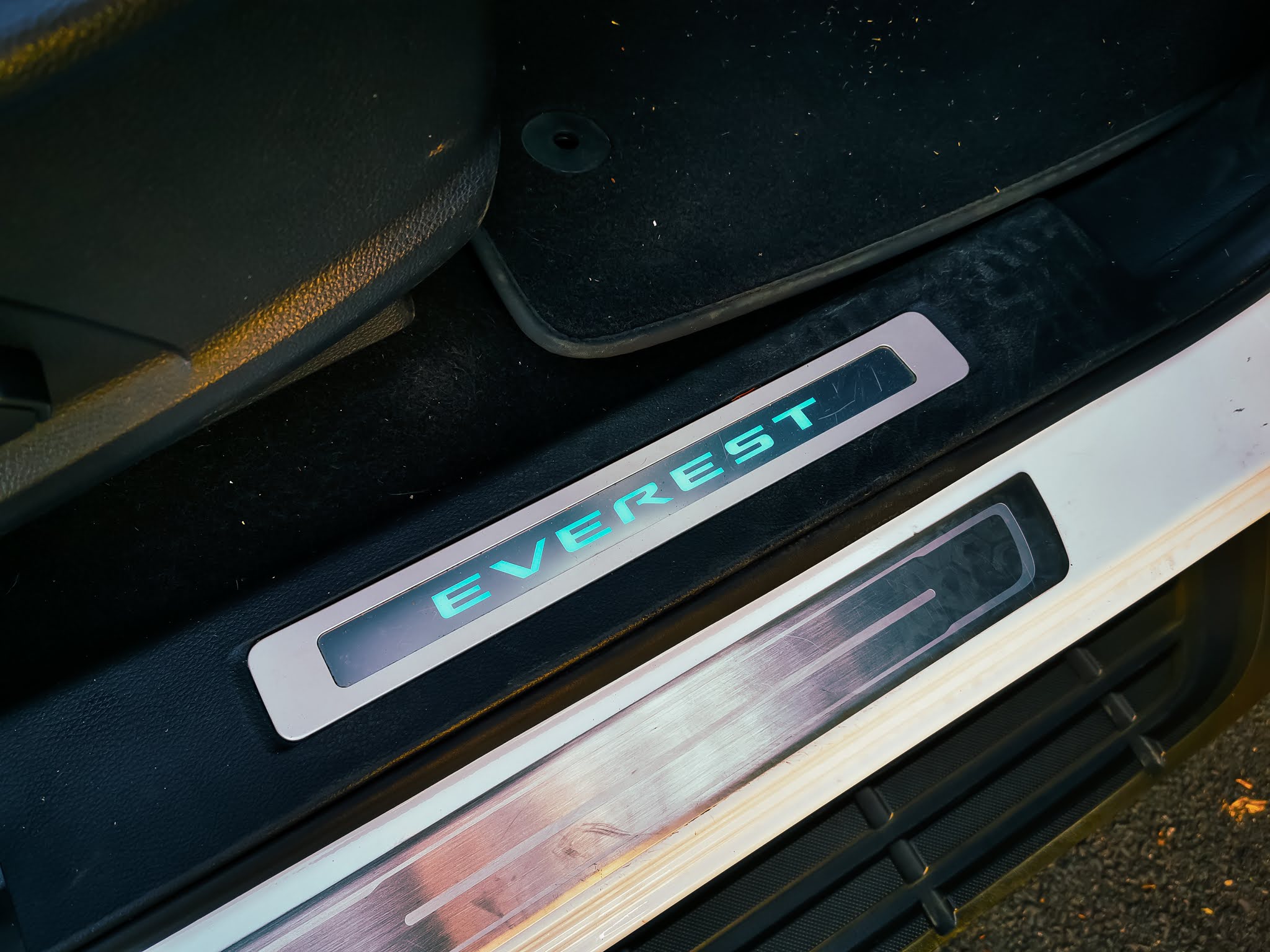
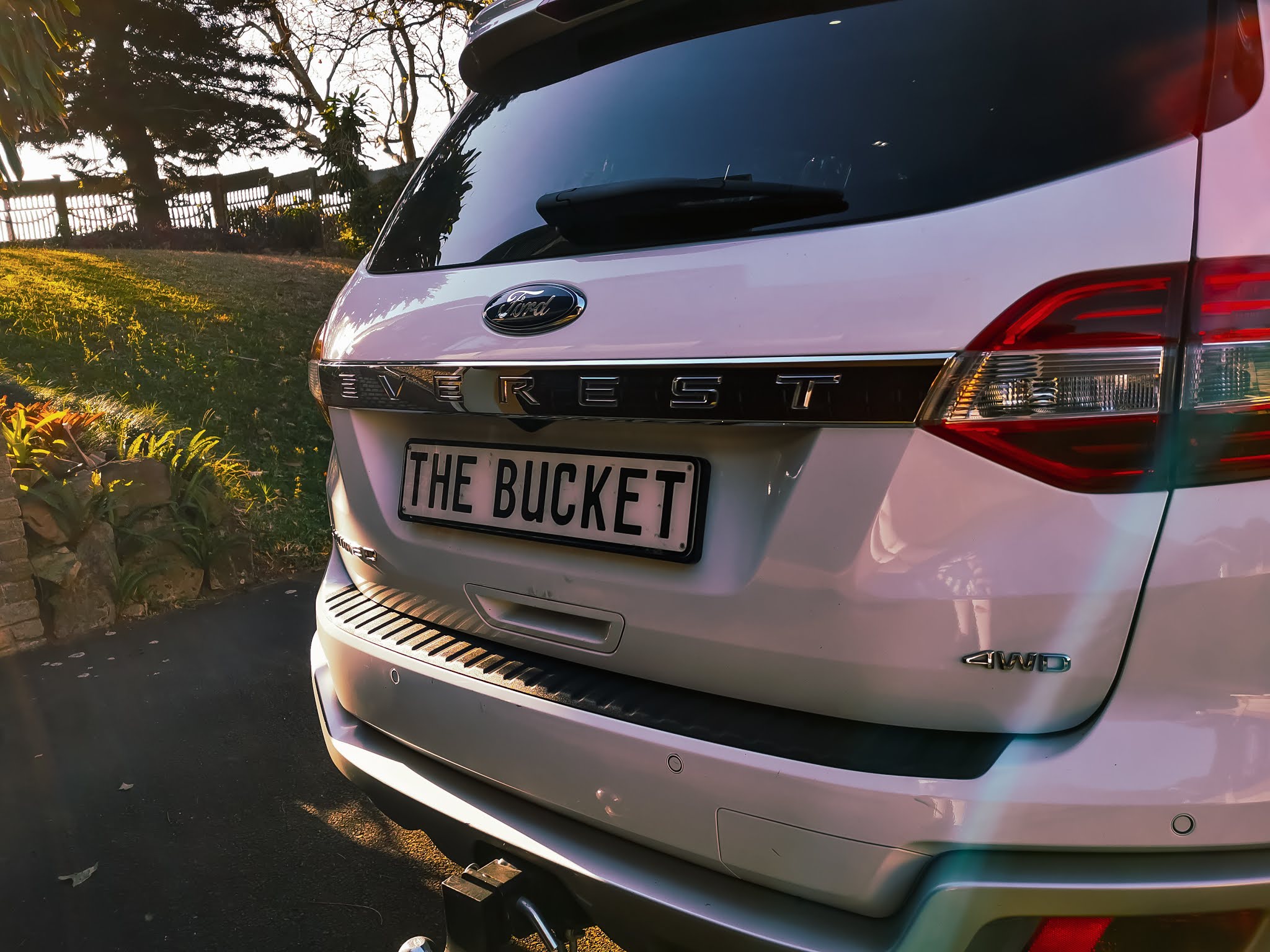
The Ford Everest now in its 3rd generation see's for the first time having a Wildtrak derivative. The Ford Everest Wildtrak offers a range of features that enhance its styling, interior, infotainment, safety, technology, comfort, and practicality. These extras make it a more premium and capable SUV, than the entry level Everest. Having driven the range topping Platinum model, I was keen to get behind the wheel of this mid level variant from the brand to see how much it differed in terms of performance and ride quality as both, the Wildtrak and Platinum come powered with the same 3.0L V6 power train. Having spent a week with it, doing the daily routes I had the chance to take it away for the weekend on some light country side exploring to get a better feel of what the car had to offer and here are my thoughts on how it handled itself. 


DESIGN

The design of the Everest is brilliant in my opinion, sticking true to its American routes, the massive frame its built on gives the car the presence it commands whether it be on the road or in the wild, this particular model, the Wildtrak offers some unique design characteristics that make it stand out from the other models in the stable, starting with the styling: 20-inch ‘Asphalt Matt Black’ alloy wheels keep the massive body up complimented by black wheel arch flares, black window trim, and Wildtrak badging and branding in black around the car. The dark colours contrasted well with the body colour of Arctic White which the one I had came in. The front of the car is really menacing with the wide grilled that integrates into the C-Clamp headlamps that follow the cars lines that lead to the cabin. The car is very box like in statue and the straight lines keep that theme going till the back. I'm a big fan of the rear light design which runs across the tailgate and has the Everest name badge in the center. My one grip would have to be the tow bar, it's a fixed one that can be removed manually and I understand the reasoning for it as it has a higher towing capacity but I would have really liked an automatic option which stows it away, especially for this and the Platinum models. Not only would help with the looks but also helps with parking it. On the interior, we have a full Ebony leather upholstery with Cyber Orange stitching, panoramic sunroof, , interior ambient lighting, which cannot change colour, unless I have no idea how to find the setting, but pretty much stock standard Everest interior. 


PERFORMANCE

As mentioned before, the Everest Wildtrak is powered by the same  3.0-litre V6 turbo diesel engine that is found in its Ranger sibling and the range topping Platinum models, this motor delivers a Power and Torque ratio of 184 kW of power and 600 Nm of torque which is coupled to a 10-speed automatic transmission. With the various driving modes available on the Everest, namely Normal, Eco, Tow/Haul, Slippery, Mud & Ruts, and Sand which is all controlled via a jog shuttle dial in the center consol, it makes going from tar roads to gravel quite simple by flicking it in the appropriate setting and the car does everything for you. Ford claimed fuel consumption is 8.5 L/100km which could be achieved on long distance travels but realistically my range was hovering around the 10.6L mark which seemed fair for a big engine like this. As mentioned, that ugly tow bar is there for a reason giving the Everest a towing capacity of 3 500 kg braked, which is a lot more than some of its rivals. The driving dynamics of the Ford Everest Wildtrak with it's V6 is a gutsy unit, consistently delivering sustained power and torque at low and high speeds. It’s torquey and plenty of its 600Nm is available across a broad rev range. The 10-speed auto transmission has had the previous-gen’s thrashiness between ratios smoothed out – and if you want to take over duties yourself you can do so via the 'e-Shifter' in this 4WD wagon. The suspension set-up – with coil springs at every corner – helps to produce smooth, composed ride and handling although can feel a bit bumpy or bouncy at times.  Off-road, the Everest has a long wheelbase making its undercarriage vulnerable to scraping rocks, tree stumps or exposed tree roots, especially during more technical 4WDing sections.


COMFORT

The cabin of the Everest is narrow but tall and second-row and the seating is a bit squeezy for three adults, especially in terms of hip and shoulder room for larger blokes, but it’d be fine with slighter adults and even gangly teens. The cabin is very quiet, with nothing much intruding in terms of NVH (noise, vibration and harshness), other than low-level wind-rush around the wing mirrors. The noise of the turbo diesel engine does come through every now and then when harsh accelleration is present but that is easily drowned out by the 8-speaker premium sound system. Like the Ranger the Everest focal point of the cabin is the  12-inch touchscreen that controls Ford’s powerful SYNC 4A infotainment system. This is the command center of the car and has wireless connectivity to Android Auto and Apple CarPlay. While in the mobile apps, it is easy to access the Ford menu with shortcuts located to the top right side corner making it easy for the driver to toggle should they wish to change some vehicle settings. The dual zone climate control can be controlled via physical knobs or via the screen as well. The Wildtrak came with heated seats but not cooling like the Platinum. The car is equipped with advanced technology, including keyless entry and start, a raft of media ports around the cabin for charging your various devices and power outlets for coolers or pumps. The seats are comfortable, with faux-leather which covers the steering wheel as well. The digital dash is an 8-inch screen which can display various information via the multi-function steering, which the digital speedometer is cool, I would have like the option for it to display the old analog style speedo. The seven seats make the Everest Wildtrak extremely useful as a people mover, and incredibly spacious when the back seats are folded down which I had it for most of my time on the weekend as away as it was only the 3 of us.  The Wildtrak has a 360-degree surround view camera, which is crucial for safe parking of this hulk. It’s an optional fitment but a very handy one if you ask me. 


VERDICT

The Ford Everest Wildtrak is a comfortable and capable SUV with a luxurious interior, advanced technology, and a smooth and powerful drive. It's a great option added to the line up for someone who is looking for a large family SUV but has a more sporty side to them instead of someone who is looking more on the luxury spectrum of the Platinum. The standard features that come with the Wildtrak along with the styling, make this car quite attractive to the young at heart who love adventure, and in my weekend away at the sea side, it caught the eye of many surfers who were keen to not only check it out but wanted to see how many mates they could fit in for a trip to Mozam. So whether you're a family looking to vacay in the berg for a week, or a troop of surfers looking for the ultimate waves, the Everest is the ideal vehicle for you and whats even better it does the daily quite well too. Yes, the size of it does take getting used to be with the help of the PDC's and cameras, you will soon master parking this thing in the tightest of spots. 


SPECIFICATIONS

Engine
3.0L Turbo Diesel V8
Gear Box
10-speed automatic
Torque
600Nm
Power
184kW
Fuel Consumption    
10.3L per 100km
Price
R1,180,200


Friday, September 18, 2020

Bucket Seat: Ford Everest Bi-Turbo Limited AWD

When it comes to SUV's in the SA market, the two heavyweights which battle for market dominance in-terms of sales figures, are the Toyota Fortuner and Ford Everest. While both are very similar in overall aspects, Toyota did have the upper hand with more engine variant offerings than Ford with them only having the 2.2L and 3.2L liter diesel options, but recently Ford South Africa have introduced their new 2.0L Bi-Turbo Diesel which is set to stir things up for them as the Everest is already a great offering and with this new engine variant it can only do good things for the brand. I had the opportunity to spend a week with the new Ford South Africa Everest 2.0L Bi-Turbo as well as take it on a cross country trip from the coast to Johannesburg to see how it goes, here are my thoughts on the car. 


DESIGN

To me the Everest has always been the best looking 7-seater SUV on the market and it still remains that with this new model receiving subtle styling enhancements but the overall looking remaining very much the same. It goes with the saying, don't fix something if it ain't broke and Ford reservedly did so. The car has that American charm to it, even though it features the Ranger front end but sporting a different grille, the way the car is sculptured with added bulk on the wheel arches, flowing lines along the side to give the side profile a very professional look before tying in perfectly at the back with the longitudinal lamps. The car is very classy and even more so in this Frozen White paint work. The model specification I had was the top of the range Limited which has 18" rims, a lot of chrome accents, ventilated brake discs up front and a whole lot of safety features. The inside also remains very similar to the previous model, pretty much the same set-up as the Ranger but more softer materials to give it that family/ luxury feel rather than that of a bakkie. 

PERFORMANCE

As mentioned, this is Ford's all-new 2.0L Bi-Turbo Diesel engine, it's teamed up with a new 10-speed automatic gearbox which combined with the performance from the engine make it a dream to drive. The old 6-speed automatic wasn't too bad and performed well with the 3.2L diesel engine but with the 2.2L it had it searched for that perfect medium but now with the 10-speed box it knows the ratios to produce the optimal performance when needed and it helps with the fuel economy. The 2.0L Bi-Turbo diesel engine produces 157kW with 500Nm of torque, with the Limited being all-wheel-drive, this torque is transferred to all four wheels and makes the car quite quick off the start on tar roads. Ford say the claimed fuel consumption to be 7.6L to the 100km, a figure that I didn't get close to on my long distance trip but then again with all the road-works on the N3 it would have been difficult to achieve this but still, keeping that figure to under 10L per 100km in a big vehicle like this, with a full load was pretty pretty impressive. 


COMFORT

So with this being the Limited model, it comes kitted out with all the nice stuff, leather seats for ALL 7 seats, my favourite party trick from this model is the automatic folding third row seating which you can control from the luggage compartment. The third row folds flat to give you even more luggage space if required. Upfront you have seat heating for driver and front passenger, the large infotainment screen with Ford's SYNC 3, this model did not have Apple Car Play or Android Auto preloaded as per  normal but there is an option for you to do that via Wi-Fi, yes you can make a Wi-Fi hotspot via the car for the entire cabin which is also pretty cool. The second row seats is as luxurious if not more than the front, they get their own zone climate control with controls at the back. Being a big vehicle you're going to need some assistance getting around so it comes with front and rear PDC's as well as a rear view parking camera. The cruise control took me a while to figure out, but once it was activated it was smooth sailing from there as it has active cruise control which slows down if it sensors the car in front of you slowing down. It has blind spot monitoring and lane departure warning as well should you stray across and not notice, which is easy to do in a big car like this. 


OFF-ROAD

Being a fully fledged off-roader, I was hoping to take it out off the beaten track but unfortunately didn't get the time to do so but you'll be pleased to know it comes with all the bells and whistles for this application.  From Hill Descent Control, Hill Launch Assist, Roll-Over Mitigation, EBD and ESP. The jog shuttle dial system for selection of road conditions make it easy for anyone to use. The front suspension is independent with coil spring and anti roll bar, while the rear being coil spring with Watt Links. The transmission is 4WD with electronic locking rear differential, with final drive 3.31. 


VERDICT

Overall this new offering from Ford which becomes the range topping model did no wrong while I had it. It's honestly still one of the best 7-seater SUV offerings on the market and while it does have stiff competition, there will be key differences which the Ford has that will win it over from the opposition. It offers a great ride, fantastic build quality and the equipment that comes as standard is great. While being a sizable car, it doesn't take you very long to get used to the size of the car when driving it around. The cabin is spacious and with the panoramic sunroof, it just gives you that illusion of it being much bigger. 

SPECIFICATIONS

Engine
2L, Bi-Turbo Diesel
Gear Box
10-Speed Auto
Torque
500Nm
Power
157kW
Consumption
7.6L/100km
Price
R819,400


Friday, June 2, 2017

Bucket Seat: Ford Everest 2.2 4WD


When Ford launched their Everest in SA about 2 years ago, it wasn't going to take the market by storm, not because it isn't a good vehicle, but because of its price tag. The launch edition only featured the 3.2 Diesel engine, whilst it is a great engine it did make the SUV damn expensive! So it was with great joy to many when Ford launched the 2.2 variants late last year. While you still get the great vehicle, but with a power train that is smaller but still capable to lug this rather large car around. A few weeks back I spent a week with the Ford Everest 2.2 AWD 4X4 and put it through some tests that I didn't even imagine I would had to! All in all it was great fun as you will soon find out. 


STYLE

The model I had was the XLS 4WD which sits one below the XLT,  it still had the great look of the Everest, and it was just accentuated with the Ocean Blue colour that it came with. You did miss those minor touches from the LTD that make it look the part though, for example, the daytime running LED lights on the front headlamps and the chromed out front grille and the larger rims, this one did  come with 17" wheels but looked rather small on it. Other than that, the car still has a great presence on the road, I mean it is probably one of the biggest SUV's available on the market, size wise and in height. Interior was pretty plain but then with an entry level variant you wouldn't expect it to have everything in it. 


PERFORMANCE

If anyone has seen or been in an Everest you will know how big this car is and why I keep mentioning it so with the smaller engine, I was a bit optimistic on how it would cope. Credit to the engineers at Ford though, the engine did deliver plenty in-terms of power and torque, the 6 speed manual transmission I had also played a part in this. Also with the 2,2 ltr diesel engine, I did notice a significant economy difference to the 3.2 engine, Ford claims it can do 7.1L per the 100km which I struggled to get near but then again I was to blame for that, it was just so much fun testing the torque on take off all the time! 

COMFORT

The Everest is a full 7 seater SUV, and its capable of carrying 7 adults more than comfortably, yes we put this to the test but bare in mind when using all 7 seats it doesn't leave much boot space. The versatility of the Everest is just great, the seats are so easy to move and drop that even a child could do them. You can have them set up in multiple configurations to suit you. Even if you have to carry an extra large item, just fold down all the seats and be amazed at how much can actually fit inside this behemoth. The cabin air is controlled by climate control and has vents throughout the cabin with the option to switch off the rear cabin AC if there is no one there. 


OFF ROADING

Whats the point in having a 4X4 if you aren't going to take it off roading right? Well that was my point exactly with the Everest, while it did a great job on my daily commute to work and back, scaring taxi's and other idiot drivers off the fast lane on the highway, it was off track where I really wanted to experience it. That weekend, some of the first snow falls were reported in the Southern end of Drakensberg and Lesotho, it was the perfect opportunity to go looking for snow with the Everest. I rang up a few mates, and we were off early Saturday morning, on the road to find the snow. We had a snow tracker, scouring the internet to see where snow sightings were, most of which were deep in Lesotho which was a bit far for our liking but the closest area with reported snow fall was Sani Pass. A route we conquered many a time in the past, so off we went!

As we got closer, we could definitely feel the snow was not too far off with the temperature dropping from 11 degrees to 3 degrees in a matter of kilometers. We didn't have our passports with us so we couldn't actually head up the pass but thought we would drive to the border and see what we could find. The short gravel road to the border is only 13 km or so but it normally is a hard gravel road that isn't as easy as it sounds. Much to our bad luck as we began our trek on this road, it began to bucket down, making the gravel turn into thick mud, almost clay which saw a number of vehicles in front of us get bogged down, eventually forcing us to turn around. We did get close enough to see the snow from a distance though, we flew our drone blindly to capture it but only ended up capturing the grass below it....suffice to say it proved to be a handy lesson in drone flying!


Heading back I decided to take the "short cut" to Nottingham Road, a popular spot in the midlands meander to have a spot of lunch. Little did I know what this shortcut had in store for us. It needed us to navigate our selves though a long gravel route, which much like the Sani Pass Road turned into a rive of mud. Thankfully the Everest off road settings came into play with us making use of majority of the settings, ice and snow mode for the icey parts, rock crawl mode for navigating around tricky escarpments and towards the end of the route, there was a pass with loose sand in which we had to manoeuvre down. Although hair raising for myself and my occupants, the Everest did manage it quite well. There were no "lets do it again" chants though once we eventually got down.                    

VERDICT

Suffice to say I put the Everest through it's paces in all types of terrain and it came out with flying colours but it again, it all boils down to the price and the value you getting with the Everest, there's still a number of things I would like to see in the car that it doesn't have. It still comes with one of those wap ariels, the car is so damn high as it is, this just makes it taller so I found myself get into a panic every time it hit something! Also while I understand it's an entry level variant, we going to need that full touch screen display, the small screen this particular model came with was so small that my cell phone screen was bigger than it. Hopefully now with SYNC 3 out, Ford would consider adopting this in most of their Everest models. Another grip is the key, it's nice but I would expect for a vehicle like the Everest to have the smart keyless system like the Mustang and Fusion come with but that's just me. It is on the whole an extremely good vehicle, while it doesn't have all the bells and whistles I might be looking for, it's more than capable of the job it has to do. It's big, spacious and fun to drive, and very versatile which just ticks all the boxes that people check when buying an SUV.


SPECIFICATIONS

 Engine
 2.2 litre Diesel 4 cylinder
 Gear Box
 6 speed manual
 Power
 115kW
 Torque
 382Nm
Fuel Economy
 7.1L/100km
Fuel Tank
80L
 Price
 R 539,000


Friday, September 16, 2016

Bucket Seat: Ford Everest vs Toyota Fortuner


The Ford Everest and the Toyota Fortuner are currently the two most popular SUV's currently on the market without a shadow of a doubt. Both in direct competition with each other offer people in the segment a good variety of options to make their decision on which one to get. Which one is better though? I know it's tricky question seeing that it depends on individual preference but having driven both in the space of two weeks I did find some high points and low points to both and in this post I'll be highlighting them and giving my verdict on which I felt was the better of the two. 


Style
In this department I can't fault either of them, both sets of designers did an amazing job for the respective vehicles. Ford has taken roots from it's American side in and beefed up the latest Everest. It's a great design, bold and masculine. Harnessing the age old Ford Slogan "Built Ford Tough". Like I mentioned in my review of the SUV. It's a complete design with no loose ends. The lines flow perfectly and tie up lovely in the back. 

Toyota on the other hand went from a fairly Conservative design in the original Fortuner and added a bottle of Saki to it. It's a radical makeover and one which I feel was needed. We were seeing too many boring designs coming out of Japan and with a popular SUV like the Fortuner, it needed something different, something edgy and that's exactly what we got. Lots of design queues from the Lexus line of the company but I'm not complaining, as mentioned in the review, it won't be everyones cup of tea but sales will be the ultimate test and so far it seems to be passing. 


Performance
While both SUV's had different power plants, they were similar enough to compare. The Everest came with Ford's 3.2 litre, 5 cylinder, TDCi engine whilst the Fortuner had a slightly smaller 2.8 GD Hi engine. Both diesel engines, with the Ford's egding it in capacity and so most of the figures as well with it having 13 more torques and 20 more kW but while the figures say one thing, it might not generally mean that the one with the higher figures is the winner. While the Everest did have more torque, I found it to be very sluggish on take off or on lower gears, with lots of tubro lag and I think the general weight of the SUV slowing it down a bit. The Fortuner however had no such issues, even with it being in Eco mode which has lower revs, it still managed to take off faster which is evident in the 0-100km times. The Ford managing this in 11.6 seconds while the Toyota chops off almost a second off that time in 10.8 seconds. 

Both SUV's came with a 6 speed automatic gearbox with manual shift options, however again with this I felt the Ford's gearbox to be a bit lethargic and slow to think while the Toyota's gear box was a bit to quick. For example while going down a hill and not pressing the accelerator, the Toyota for some reason would down change and have a high rev all the way until you pressed the peddle again. I found this really odd and annoying at times. The Ford's gear box took a bit of time to think whether it needs to change gear or not, again forcing the revs high. The one thing I did like is that the Fortuner came with paddle shifts. Now I know what you're thinking, paddle shifts on an "SUV?!" But trust me it works like a beaut! 


Comfort
I'm bigger than your average guy so I appreciate spacious cars and both of these SUV's are extremely spacious. They are both 7 seaters and can seat seven adults comfortably. While there is plenty of space, are the seats comfortable tough? With the Ford, yes they were comfortable and it did come with leather seats but I found the quality of the leather to be a bit cheap, it gave that very slippery feel to it and just looked dull. Maybe it was the grey colour but I was not impressed. 

The Fortuner though, I couldn't stop raving about the leather in this car. From the seats to the leather that was used to cover the dash board, it felt amazing to touch and even better to sit on. The Toyota did come with a few creature comforts that were non existent in the Everest, like electronic front seats while the Everest was manual but the ride quality in the Everest seemed to have shaved the Toyota's as what let it down was the engine noise in the cabin. 


Tech
This one surprised me, having owned Toyota's for most of my life I know they were not ones to embrace technology like the rest of the manufacturers but I think they had more to offer in the Fortuner than what the Everest had. To start off with, keyless entry for the Toyota with a push button start, the Everest? Normal key, very boring. As mentioned before, the Toyota front seats are electronic, the Everest? Manual. Both Instrument clusters had a display to it but I think the Everest's layout was better and while it did seem complicated to work at first, it was pretty easy with the steering wheel controls to figure out what you wanted displayed and where, the overall layout looked better with the large cylindrical rev counter with the two digital displays either side of it. 

The touch screen in the Ford was better and slightly bigger compared to the Toyota, also it had more to offer. The Toyota also lacked PDC's, which I found extremely odd for such a big vehicle. Both SUV's offered blue-tooth phone and audio streaming with effortless syncing and usage. The sound system on the Everest was clearly better than the Fortuner. Not sure if you get to upgrade the sound package in the options list on the Toyota's but it would be great if they did. Both SUV's lacked Satellite Navigation, which for a 4x4 should be standard and a waste of those big touch screens. On the head lights, Toyota came with Hi Beam LED's whilst the Everest had your normal headlamps if yesteryear. 


Storage
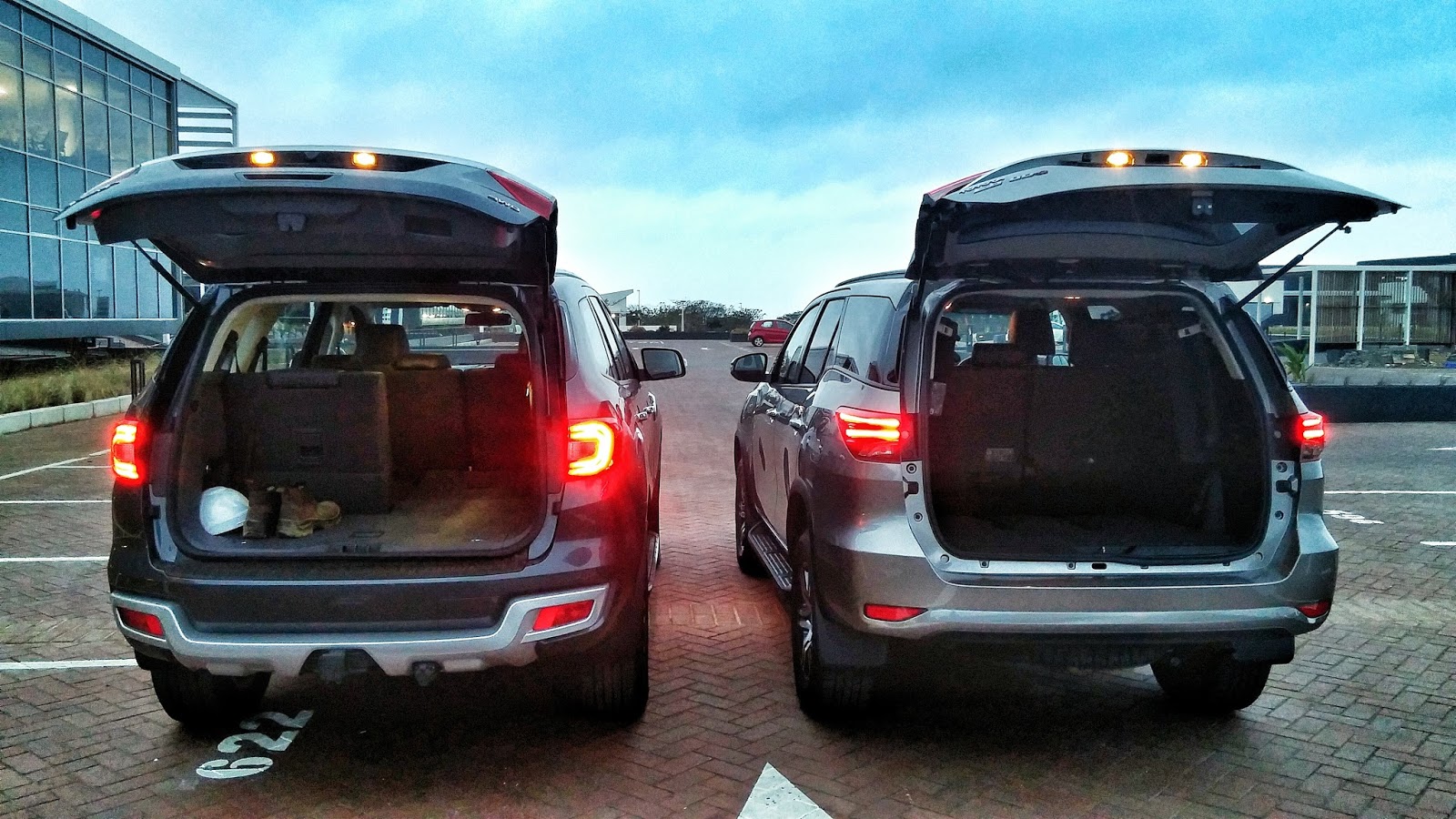
Both vehicles offer more or less the same volume of storage with the Toyota edging it by have it's spare wheel under the car as apposed to the Everest having the spare wheel in the boot. However, Toyota's fold up back seats do take up more space and does hamper the capacity a bit. As mentioned in the respective reviews, if all 7 seats are in use, it does reduce luggage capacity tremendously. 


Offroad
Although you would find 90% of these SUV's on the road for most of their lifespan, make no mistake, when you take either of them off road, they both can handle their own. The Everest easy terrain selection is a wonderful addition which is simple enough for any novice to understand and operate. Choose your type of terrain and the car does the rest of the work for you. Now as easy as the Everest was, that's not to say the Fortuner's was rocket science to figure out. Everything is pretty self explanatory and like the Everest, the car does everything for you. Many have asked if these technology advancements in these cars kill the joy of off roading, I honestly don't think it does, if anything it helps you a lot. 


Verdict
I'm not the type of guy to say a certain car is better than the next because it all comes down to the preference of the buyer. Both vehicles are great but as mentioned they each have their flaws. So instead of saying one is better than the other, which there is isn't a clear winner, I'd say which I would rather buy based on my time with each. For that my choice would have to be the Toyota Fortuner, I really really really love the Ford Everest but for multiple reasons I chose the Fortuner over it. For one, the 2.8 GD-6 is the range topping Diesel model but there is a higher topping petrol version in the V6 but still the amount of things that come packed into this car is incredible. I've never seen a Toyota so well equipped, the Everest on the other hand was the bottom of the range XLT model and while the top of the range Limited did come with all the bells and whistles, the XLT is still R22,000 more than the Toyota! Resale on the Fortuner is a winner as it is a market favourite and Toyota's reputation in the used car market surpasses any other manufacturer. Fuel consumption, even though the figures in the book favour the Ford, I found the Toyota gave me the better consumption of the week I had it, so for those reasons I would have the Fortuner, also I think they did a great job on the styling, it's really an eye catcher and looks even better at night. 


Specifications

Toyota Fortuner 2.8 GD-6
Ford Everest XLT
2.8 litre GD Hi
3.2 litre Duratorq TDCi
6 Speed Automatic gear box with paddle shift
6 Speed Powershift Automatic gearbox
130kW
147kW
450Nm of torque
470Nm of torque
8.5ltr/ 100km
8.2ltr/ 100km
0-100kph in 10.8 seconds
0-100kph in 11.6 seconds
R613,200
R634,900