Google Tag

banner

Showing posts with label 2.8 GD-6. Show all posts

Wednesday, August 22, 2018

Bucket Seat: 2018 Toyota Hilux Dakar Edition


Before I start this review, I'm going to level with you, I've never understood the fascination with owning a double-cab bakkie. There's no doubt its a popular segment because you see more and more of these things on the road, and more often than not, people who buy them rarely purchase them for the purpose they are made for, which is what boggles my mind even more! Why pay so much for something that you'd probably use 10 times maximum, for actual double cab work during the time you will have it? To start off with, you got a bin, which most people tend to not cover with a canopy for aesthetic purposes, so you get that tarpaulin type stretchy cover for it, some fancier ones come with an aluminium frame so water doesn't collect in it thereby making it a portable pool but to remove this frame and cover is a bitch! So while it has adequate storage, it's not the easiest to access. Then you get to the back seats, which have gotten bigger over the years but still not the most comfortable place to sit, for one, the door is narrow, secondly it's high and the seats are raised, so it isn't very easy to get in there, all of this is oblivious to the front passenger and driver since everything seems pretty normal to them. 


Okay, one thing I can agree is that most manufacturers are making some damn good looking double cabs and while they not only look good, they are brilliant vehicles in their own respect. Take for example the Hilux, which I am talking about today, apart from being one of the most trusted and reliable bakkies on the market, it also proved it's self in the worlds toughest rally's, the Dakar which is what this limited edition version is all about, it's to celebrate the achievements of their Gazoo Racing team in the 2018 Dakar Rally. The limited edition Dakar Hilux is available in two engine variants, which are the very popular 2.8 GD-6 Turbo-Diesel and the 4.0L Petrol V6, we had the Turbo-Diesel 4x4 on test and here's how it went down. 


DESIGN

Styling on the Hilux has been its main downfall when compared to its competition, while it didn't look particularly bad, the other bakkies on the market just looked better. However, Toyota realised this and with this model made some minor tweaks which did the vehicle a world of good. The Dakar comes with redesigned grille which will flow onto the rest of the Hilux range in due course but the Dakar's grille is blacked out. It adds so much more character to the Hilux, gives it more presence and goes more in line to the bigger vans offered by Toyota in the US. Toyota also threw some Dakar badges and stickers around the car which, isn't as in your face like some of those fake "Raptor" decals but definitely add to the aesthetic appeal. The Dakar also has revised head lamps which feature an LED row cluster of daytime running lights which flow into the new grille and they've upgraded the headlamps to LED. The Dakar Edition also has the exterior mirrors and door handles finished in high gloss black as well as some chrome finishing on the metal work. Overall, a very appealing package by Toyota and one that should reel in some sales for those who were opting to go for the other brands. 


PERFORMANCE

I can't speak highly enough about this 2.8L GD-6 engine from Toyota, I enjoyed it in the Fortuner and with the Hilux it feels more at home. The only gripe I might have is that it is quite loud, even when idling, but then again you have to remind yourself you are in a bakkie and not a luxury SUV. The power derived from the engine produces 130kW and 420Nm of torque, which translates to effort free driving on normal roads but where it shows its true strength is on the paths less traveled.  That torque comes really handy when you're off road, and while many people told me its impossible to get stuck with the Hilux, I did. But it entirely was my fault, I had it in the wrong settings while driving in soft sand. Toyota made the 4x4 controls really easy to use, it's basically like an aircon selector knob, to select what mode you want to be in. So I just switched the diff lock on, put it in low 4 and the bakkie practically got unstuck itself. I was amazed at how relatively easy it got unstuck, even with half the tyres buried in sand. 


COMFORT

Like I mentioned earlier, a double cab bakkie isn't really built for comfort, especially the second row of seating but I have to admit, the inside of the Dakar was really nice. The seats were covered in premium black leather with white stitching. The steering wheel also leather covered with high gloss bottom, and full multi-function controls for audio and vehicle status. The Dakar comes with a large touch screen infotainment center, and has satellite navigation standard on all Dakar models. The cab comes with climate control air-conditioning which I'm sure the guys on the rally would love but doubt they get those in the actual rally spec Hilux. Moving into the back, which features a full bench seat, also covered in that nice leather with the fancy stitching and to their credit, is much more spacious than some of the other double cab bakkies I've sat in before. 


VERDICT

While I did enjoy my time with the Hilux Dakar Edition, especially when scaring away slow drivers in the fast lane of the highway, it didn't change my perception of double cab bakkies in general. I do however have a better understanding of why people would buy these cars. The only problem I'd have if I owned one would be people I know calling me on the weekends asking me to help them transport stuff for them since I got a bakkie. While the competition in the segment might still be hotly contested and even with new manufacturers like Mercedes-Benz coming to the party, you cannot write-off the Hilux. It's been through it all and still remains one of the best on the market. Credit to Toyota for not resting on their heritage and laurels but also putting out a great product every time and sales figures just goes to prove that. 


SPECIFICATIONS

 Engine
 2.8L GD-6 Turbo-Diesel 
 Gear Box
 6 Speed Manual
 Power
130kW
 Torque
420Nm
 Top Speed
180Kph
 Economy
7.6 L/100km
 Price
 R601 100


Photography by Mavric Photo

Friday, September 16, 2016

Bucket Seat: Ford Everest vs Toyota Fortuner


The Ford Everest and the Toyota Fortuner are currently the two most popular SUV's currently on the market without a shadow of a doubt. Both in direct competition with each other offer people in the segment a good variety of options to make their decision on which one to get. Which one is better though? I know it's tricky question seeing that it depends on individual preference but having driven both in the space of two weeks I did find some high points and low points to both and in this post I'll be highlighting them and giving my verdict on which I felt was the better of the two. 


Style
In this department I can't fault either of them, both sets of designers did an amazing job for the respective vehicles. Ford has taken roots from it's American side in and beefed up the latest Everest. It's a great design, bold and masculine. Harnessing the age old Ford Slogan "Built Ford Tough". Like I mentioned in my review of the SUV. It's a complete design with no loose ends. The lines flow perfectly and tie up lovely in the back. 

Toyota on the other hand went from a fairly Conservative design in the original Fortuner and added a bottle of Saki to it. It's a radical makeover and one which I feel was needed. We were seeing too many boring designs coming out of Japan and with a popular SUV like the Fortuner, it needed something different, something edgy and that's exactly what we got. Lots of design queues from the Lexus line of the company but I'm not complaining, as mentioned in the review, it won't be everyones cup of tea but sales will be the ultimate test and so far it seems to be passing. 


Performance
While both SUV's had different power plants, they were similar enough to compare. The Everest came with Ford's 3.2 litre, 5 cylinder, TDCi engine whilst the Fortuner had a slightly smaller 2.8 GD Hi engine. Both diesel engines, with the Ford's egding it in capacity and so most of the figures as well with it having 13 more torques and 20 more kW but while the figures say one thing, it might not generally mean that the one with the higher figures is the winner. While the Everest did have more torque, I found it to be very sluggish on take off or on lower gears, with lots of tubro lag and I think the general weight of the SUV slowing it down a bit. The Fortuner however had no such issues, even with it being in Eco mode which has lower revs, it still managed to take off faster which is evident in the 0-100km times. The Ford managing this in 11.6 seconds while the Toyota chops off almost a second off that time in 10.8 seconds. 

Both SUV's came with a 6 speed automatic gearbox with manual shift options, however again with this I felt the Ford's gearbox to be a bit lethargic and slow to think while the Toyota's gear box was a bit to quick. For example while going down a hill and not pressing the accelerator, the Toyota for some reason would down change and have a high rev all the way until you pressed the peddle again. I found this really odd and annoying at times. The Ford's gear box took a bit of time to think whether it needs to change gear or not, again forcing the revs high. The one thing I did like is that the Fortuner came with paddle shifts. Now I know what you're thinking, paddle shifts on an "SUV?!" But trust me it works like a beaut! 


Comfort
I'm bigger than your average guy so I appreciate spacious cars and both of these SUV's are extremely spacious. They are both 7 seaters and can seat seven adults comfortably. While there is plenty of space, are the seats comfortable tough? With the Ford, yes they were comfortable and it did come with leather seats but I found the quality of the leather to be a bit cheap, it gave that very slippery feel to it and just looked dull. Maybe it was the grey colour but I was not impressed. 

The Fortuner though, I couldn't stop raving about the leather in this car. From the seats to the leather that was used to cover the dash board, it felt amazing to touch and even better to sit on. The Toyota did come with a few creature comforts that were non existent in the Everest, like electronic front seats while the Everest was manual but the ride quality in the Everest seemed to have shaved the Toyota's as what let it down was the engine noise in the cabin. 


Tech
This one surprised me, having owned Toyota's for most of my life I know they were not ones to embrace technology like the rest of the manufacturers but I think they had more to offer in the Fortuner than what the Everest had. To start off with, keyless entry for the Toyota with a push button start, the Everest? Normal key, very boring. As mentioned before, the Toyota front seats are electronic, the Everest? Manual. Both Instrument clusters had a display to it but I think the Everest's layout was better and while it did seem complicated to work at first, it was pretty easy with the steering wheel controls to figure out what you wanted displayed and where, the overall layout looked better with the large cylindrical rev counter with the two digital displays either side of it. 

The touch screen in the Ford was better and slightly bigger compared to the Toyota, also it had more to offer. The Toyota also lacked PDC's, which I found extremely odd for such a big vehicle. Both SUV's offered blue-tooth phone and audio streaming with effortless syncing and usage. The sound system on the Everest was clearly better than the Fortuner. Not sure if you get to upgrade the sound package in the options list on the Toyota's but it would be great if they did. Both SUV's lacked Satellite Navigation, which for a 4x4 should be standard and a waste of those big touch screens. On the head lights, Toyota came with Hi Beam LED's whilst the Everest had your normal headlamps if yesteryear. 


Storage
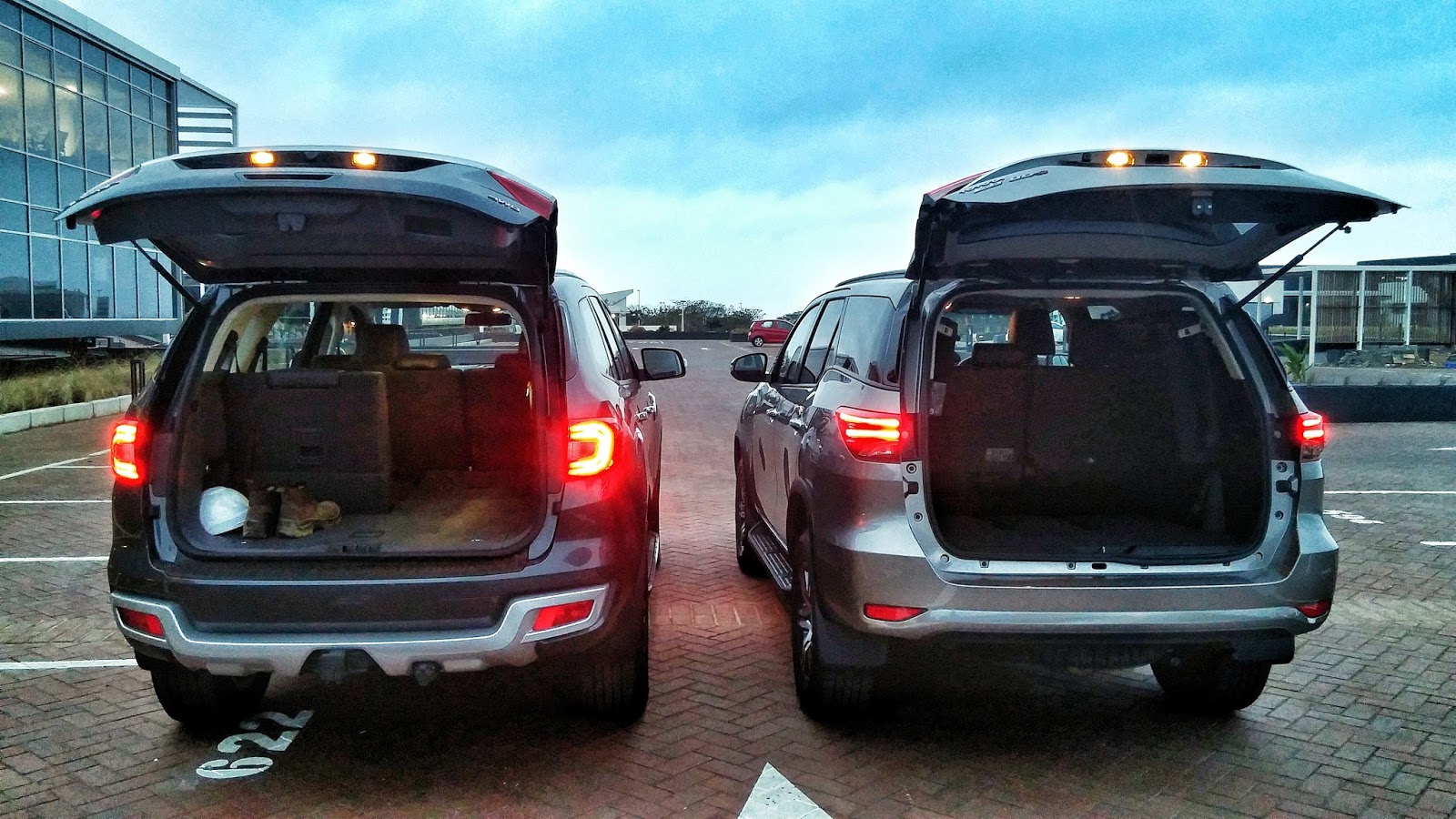
Both vehicles offer more or less the same volume of storage with the Toyota edging it by have it's spare wheel under the car as apposed to the Everest having the spare wheel in the boot. However, Toyota's fold up back seats do take up more space and does hamper the capacity a bit. As mentioned in the respective reviews, if all 7 seats are in use, it does reduce luggage capacity tremendously. 


Offroad
Although you would find 90% of these SUV's on the road for most of their lifespan, make no mistake, when you take either of them off road, they both can handle their own. The Everest easy terrain selection is a wonderful addition which is simple enough for any novice to understand and operate. Choose your type of terrain and the car does the rest of the work for you. Now as easy as the Everest was, that's not to say the Fortuner's was rocket science to figure out. Everything is pretty self explanatory and like the Everest, the car does everything for you. Many have asked if these technology advancements in these cars kill the joy of off roading, I honestly don't think it does, if anything it helps you a lot. 


Verdict
I'm not the type of guy to say a certain car is better than the next because it all comes down to the preference of the buyer. Both vehicles are great but as mentioned they each have their flaws. So instead of saying one is better than the other, which there is isn't a clear winner, I'd say which I would rather buy based on my time with each. For that my choice would have to be the Toyota Fortuner, I really really really love the Ford Everest but for multiple reasons I chose the Fortuner over it. For one, the 2.8 GD-6 is the range topping Diesel model but there is a higher topping petrol version in the V6 but still the amount of things that come packed into this car is incredible. I've never seen a Toyota so well equipped, the Everest on the other hand was the bottom of the range XLT model and while the top of the range Limited did come with all the bells and whistles, the XLT is still R22,000 more than the Toyota! Resale on the Fortuner is a winner as it is a market favourite and Toyota's reputation in the used car market surpasses any other manufacturer. Fuel consumption, even though the figures in the book favour the Ford, I found the Toyota gave me the better consumption of the week I had it, so for those reasons I would have the Fortuner, also I think they did a great job on the styling, it's really an eye catcher and looks even better at night. 


Specifications

Toyota Fortuner 2.8 GD-6
Ford Everest XLT
2.8 litre GD Hi
3.2 litre Duratorq TDCi
6 Speed Automatic gear box with paddle shift
6 Speed Powershift Automatic gearbox
130kW
147kW
450Nm of torque
470Nm of torque
8.5ltr/ 100km
8.2ltr/ 100km
0-100kph in 10.8 seconds
0-100kph in 11.6 seconds
R613,200
R634,900