Google Tag

Showing posts with label Sporty. Show all posts

Friday, February 21, 2025

Bucket Seat: Volkswagen Tiguan 1.4 TFSI R-Line

Over the December period I got to spend it with the new Volkswagen Tiguan. The third generation of the popular mid-sized family SUV was launched in the country last September but since then not many were to be seen on the roads, well at least here in Durban which has a strong VW presence. I couldn't help wonder why, given its good looks, modern interior, technology packed and great list of safety features, what could have been deterring prospective buyers from buying this car? The previous generation was a firm favourite in the segment, so much so they even brought the performance version Tiguan R which was in high demand. Now many of you must be already saying, "it's because of the price", but Volkswagen SA have done extremely well with the pricing, keeping it relatively equal to the outgoing model, so it definitely couldn't have been that. I was hoping that by spending a month with it, I could nail down the reason, so here's my thoughts that and more importantly, the car itself. 


From the day it rolled into my driveway, I was grinning like a child, the Tiguan is a gorgeous looking car but the one that was handed to me, came in the R-Line package in Persimmon Red Metallic paint. It was a looker, with its curvaceous body, sporty lines, mesmerize lights and menacing stance it made sure to get attention wherever I went. The styling, especially on the R Line really gives the overall body a great look, the main focus being the large front grille which almost looks like a mouth open sucking in all the air as you drive. The solid panel grille above that which spans around the front joining the headlamps with the VW emblem in the center. The comments I got about the looks during my time with it were all positive, while it was a modern design its core still remained true to the VW design language. There was nothing extreme to deviate it away from the classic SUV look, unlike what we're seeing coming out of China and that is what the loyal VW customers expect from their brand, something that fits the mold of a family SUV but with that added German robustness.


While the outside drew a lot of attention, its the inside where I spent my time and let me tell you, it was quite a place to be. A fresh new take on an interior from VW with elements borrowed from other newer models like the Golf 8.5 and the Touareg. The first thing that gets your attention is the large infotainment screen, measuring in at 12.9-inch its the main focal point of the cabin. It feels like its floating on the dash and this illusion gets better at night with the ambient lighting which has 30-colours to choose from with a bi-colour display, so the combinations you can play around with really can make your imagination go wild. The instrument cluster is a 10-inch digital cockpit that has the usual VW displays which can be configured and changed from the multi-function steering wheel. I'm really please VW has gone back to conventional buttons here, and not the haptic type that we all loathed on the Golf 8 GTI..... however, they could have designed new buttons and not just lift them up from the previous Tiguan. The steering wheel is nice, being leather wrapped give its that premium feel with perforations where your palms should sit when holding it. While VW have gone back to conventional buttons for the steering wheel, they still chose to keep some haptic sensitive buttons for the volume, climate control and sunroof. The volume can be controlled from the steering wheel so no issues from me thee, however, adjusting the climate control proved to be an annoying task while driving, you require some level of attention to what you're doing which distracts you from the road, same goes for the sunroof wen wanting it in the tilt position, sliding gestures to open and close are fine but trying to get your finger hit dead center to tilt seemed like mission impossible at times.


Other cool tech that came in the Tiguan was the wireless mobile phone connectivity, which is pretty much the norm in any new Volkswagen, the cabin is very minimalist, so there isn't much to play around with apart from the infotainment screen however, VW have added a jog shuttle control which serves a dual purpose, in normal setting its a volume knob, yes, that makes it three ways to control the volume and much better than that haptic sensor thing below the screen and when you push it in, it allows you to select the various driving modes offered. The Tiguan has 4 USB C charging ports, 2 up front that is covered by a flip tray which has the wireless charging mat below and 2 additional USB C ports for the rear passengers. The interior as mentioned is simple but well laid out, my one gripe would be the extensive use of plastics, I realise this might be a mixture of cost cutting and weight saving but especially with the long solid pieces, they tend to creek when driving in hot weather. What I did love is how the ambient lighting is integrated into the dash panels with a matrix like pattern that lights up at night and really adds another element to the interior experience. This model also came with a large panoramic glass sunroof which during summer to have open will give you a nice roast, so I tend to only have the curtain open at night. 


Lets talk about the power under the hood, at launch the Tiguan was only launched in the 1.4L TSI Petrol engine, now there is the 2.0L TSI Petrol and 2.0L TDI motors on offer, so my holiday wheels was the 1.4L TSI and while many did ask "Isn't it under powered?", truth be told, for 90% of my driving, it was just fine. On highways when you need that extra oomf it found itself searching for power but with the 7-speed DSG there to optimally change gears, the lack of power was there for just a few seconds. The great thing about the DSG is the way helps the motor get the best from each gear, not over straining the engine and this plays a major role in keeping that fuel economy down. Within the 30 days, I filled five full tanks of fuel, averaging about 52L every time, and I did just over 4000km with it, so giving me about 800km on every time I filled up. That's not bad from a 55L tank with a "small engine that can't cope".


My long distance trip with it to Johannesburg would be the ultimate test for the Tiguan , apart from seeing how the engine coped with the load, it was also a way to test the luggage capacity as it would be up against my mum! Many don't know this but people in Johannesburg don't get anything there, so my mother feels it is her duty to buy everything in Durban to take up for her sisters and my siblings, completely forgetting that we need to carry clothes as well. My plans of carrying my golf clubs with were dashed when I saw the 4 cooler boxes lined up in the passage to be loaded before we hit the road but with 3 luggage bags, an assortment of boxes and the cooler boxes packed in, the automatic tailgate closed without a fuss and it was time to hit the road. Seeing that it was just the three of us traveling, my mother felt that the unused seats in the back also deserved to be filled, so there was more things added to that. With a load, driving up country to higher altitude, the Tiguan felt at ease, with the construction and trucks in KZN, it was difficult to set the cruise control so I waited till we passed halfway to test it out. With all the functions on the steering wheel it was easy to set a speed and with the adaptive technology, also set a following distance to the car in front of you and I let it do the work. While it is a cool feature, it works well when the other drivers on the road know how to drive, I had loads of people cut in front of me which then kicks in the breaking since the minimum distance has been exceed so there were times the car would slow down right to 60kph to maintain that gap but that is no fault of the cars, it's just rather annoying to have that break in momentum. 


The comfort of the drive was rather special, the ride quality was smooth with the shocks coping well with the various surfaces it traversed on. The climate control managed the temperature in the cabin but like I said, I had to close the curtain on the sun roof as the sun got quite strong over the Free State. After halfway I thought it would be the best time to test the massaging seats out, to stimulate the blood flow, with the various options of massages and the choice of intensity, this optional extra was becoming my favourite of the car. Applying just the right amount of pressure making your back and shoulders relaxed after a good few hours of driving. Not too relaxing as you don't want to be falling asleep at the wheel now, also it has a time limit so the most you can do is 30 minutes at a time. Overall the trip to and from Joburg with the Tiguan was a great success with all the passengers happy and all the goods delivered safely, on the journey up I averaged 7.2L per 100km and on the way down this dropped to 6.5L per 100km, so pretty efficient if you ask me. 


While in Durban, I tend to get up to lots of things, from going to the beach for a run, to playing golf with mates and taking long drives for special lunches and dinners. For this, the Tiguan proved to be a worthy companion as well, rocking up to one of Durban's prestigious golf clubs in the striking looking SUV, it sure did turn some heads, what was even better is that I managed to fit the entire four ball in the car, all four bags and 4 players with ease, no dropping of the seats or anyone sitting cramped up. To say that is impressive is being unkind to the Tiguan, it had many other spectators at the golf club equally impressed. So, again, that luggage compartment of 652L cant pack a lot! With the torque derived from that TSI motor, the car can pull the load too. 

Overall my 30 days with the Tiguan was faultless to say the least, while there were niggles that I picked up with the quality of certain materials and the slight lag of power on highway driving, I don't see that as major contributors to the low sales. I personally think it is the general consumer thinking that the 1.4L TSI engine is inadequate for their requirements so they were waiting for the 2.0L options to come out. While this may get more sales, the major issue VW and most of the other European brands are facing is competition from the East. The Chinese have infiltrated the market tenfolds with new brands coming in every week it seems, with each one offering more for less than the other. While these cars do offer a lot for a small price tag, it still is very early to tell if they will be worth it in the long run. With trusted names like VW, you still have peace of mind knowing you have a solid German vehilce, and the loyalist will agree but when push comes to shove, if you can be saving yourself an extra R6,000 a on a car installment, the answer is a no brainer for many. It's a pity though because Volkswagen have a great third generator of their much loved SUV, I doubt it will see the sales high as the previous generation but it should be able to take a stake in the market. 

SPECIFICATIONS

Engine
1.4 TSI
Gear Box        
7-speed DSG Auto
Torque
250Nm
Power
110kW 
0-100km
9.2 seconds
Price
R781,600*  base R Line


Thursday, September 19, 2024

Bucket Seat: Range Rover Velar 300D Dynamic HSE


I always maintained the Range Rover Velar was for men who secretly like the Evoque but didn't want to buy the Evoque for fear of their masculinity being in question. Not that there is anything wrong with the Range Rover Evoque, but it is a bit small and you will struggle to get a set of golf clubs in the boot. So maybe the designers down at Range Rover figured they'd make something that has the sleek lines of the Evoque but with more space and hence the Velar came about. Of course that reasoning is totally made up in my head and they probably needed a mid-sized SUV to fit their line up. Not too long ago I got to spend a week in the Velar 300D in Johannesburg, the Range Rover Velar 300D is part of the luxury midsize SUV lineup from Land Rover, and it perfectly balances sophisticated design with advanced engineering. The car is a looker of note and while it not have the bulky presence of its bigger brother the Range Rover Vogue, it still commands respect on the roads when driven. 


DESIGN

The Velar’s design is sleek, minimalist, and futuristic, with smooth lines and a floating roof that makes it instantly recognizable. Its flush door handles, slim LED headlights, and coupe-like profile give it a unique stance that sets it apart from other SUVs in its class. The 300D comes with 21-inch alloy wheels as standard, with options to upgrade to even larger 22-inch alloys for a sportier look, this is standard when ordering the Velar with the R-Dynamic kit. The rear design is equally impressive, featuring dual exhaust outlets and a clean, minimal tailgate with striking taillights. The Velar stands out as one of the most attractive SUVs on the road, balancing elegance with an athletic edge. The profile of the Velar is to be admired, hence during my time I parallel parked this beauty on every occasion I could, preferably in front of a cafe, so I can sit and sip on my coffee while admiring the lines of the car and watch as passers by gazed into its charm. I quite like the paint work Range Rover is doing with their cars, this model came in Varesine Blue and had the details finished of in a bronze colour that really enhanced the look of the car. The interior design has gone completely minimalist, and its practically a carbon copy of the rest of the Range Rover range, just adapted to suit the size of the car. 


PERFORMANCE

The "300D" refers to the turbocharged 3.0-liter inline-six diesel engine, which combines decent power with good fuel efficiency, appealing to those who prefer a more efficient yet still powerful engine option.The 300D engine is a 3.0-liter turbocharged diesel, delivering 221kW of power and 650 Nm of torque. With this engine, the Velar accelerates from 0 to 100 km/h in approximately 6.5 seconds, impressive for a vehicle of its size and weight. The eight-speed automatic transmission is smooth and responsive, making everyday driving a breeze, whether in the city or on the highway. One of the standout features is the inclusion of mild-hybrid technology, which helps to improve fuel efficiency and emissions, especially during stop-start traffic. In terms of fuel economy, the Velar 300D achieves around 8 liters per 100km on highways, with slightly higher figures in city driving. While it's not a full off-roader like the classic Range Rovers, it retains a good deal of Land Rover’s Terrain Response system and All-Wheel Drive (AWD) capabilities, meaning it can handle moderate off-road conditions and weather challenges with ease. The Velar is designed with luxury and comfort in mind, and that is immediately evident once behind the wheel. The adaptive air suspension provides a smooth, float-like ride, soaking up road imperfections and making long journeys relaxing. The steering is precise, and while the Velar’s focus is not on sports-like agility, it is still composed around corners, with minimal body roll for a vehicle this size. In city driving, the Velar feels nimble enough despite its size, and active driver assistance features (such as lane-keeping assist, adaptive cruise control, and parking sensors) enhance the driving experience, making tight city streets easier to navigate.


COMFORT

Step inside the Velar, and you’re immediately greeted by a plush, luxurious interior. Premium materials such as leather, brushed aluminum, and high-quality plastics are found throughout. The seats are extremely comfortable, with the option of heating, cooling, and massage functions for both the driver and passengers, this is an optional extra. Unlike previous models which featured a dual touch screen, the minimalistic design of the cabin now incorporates a 11.4-inch infotainment touch screen,. This controls pretty much everything in the cabin, from the radio, to the GPS as well as climate control.  The UI, which at first glance looks pretty simple to operate can become a bit complicated when diving into the options and controls of the cars full capabilities but still, to do the important stuff is quite easy and with the built-in wireless mobile app connectivity, you will be projecting your phone most of the time. The Velar comes with a Meridian sound system, ensuring passengers enjoy top-tier audio quality. Additionally, the system includes navigation with real-time traffic updates, a 4G Wi-Fi hotspot, and various connected services like remote vehicle monitoring through the Land Rover app. The cabin is quiet thanks to excellent sound insulation, and the Velar's panoramic sunroof adds to the open, airy feel. In terms of space, both the front and rear seats offer ample legroom, and the cargo capacity is decent for its class, offering 558 liters of boot space, which can expand with the rear seats folded. The driver's display is a fully digital 12.3-inch TFT unit, which is customizable to show everything from maps to vehicle information.


SAFETY

The Velar, like any other car from the Land Rover stable features a host of safety features, starting with the 360 camera system, it gives the driver a complete overview of the car and its surrounds, so navigating this car at low speeds is made easier with this. Adaptive cruise control is pretty intuitive and responsive when in use, it monitors the cars around you and not just the ones in front, this is also aided by the lane-keeping assist which keeps the car in line when you on the open road. There is park assist to help you get into those tricky spots or, if you like me want to admire the cars side view, and parallel park it everywhere, you can let the car do it for you! Other key safety features include Autonomous Emergency Braking: Detects potential collisions and applies the brakes if necessary. Blind-spot monitoring, Rear cross-traffic alert, Lane departure warning, Traffic sign recognition and Driver condition monitoring. The Velar has earned high marks in various safety tests, making it a secure choice for families.


VERDICT

The Range Rover Velar 300D stands out for its combination of elegance, luxury, and practicality. While it's not designed to be a hardcore off-roader, it offers more than enough capability for most drivers and excels in providing a plush, tech-laden cabin, refined on-road manners, and a design that will turn heads. For those in the market for a luxury SUV with a powerful yet efficient diesel engine, the Velar 300D is a solid choice. It’s an ideal vehicle for individuals or families who value style, comfort, and technology in their driving experience.


SPECIFICATIONS

Engine
6 cylinder, 3-litre Turbo Diesel
Gear Box
Automatic
Torque
650Nm
Power
221kW 
Fuel Economy    
7.3L per 100km
Price
R1,991,100*
*base price


Friday, December 10, 2021

Bucket Seat: Audi RS Q3


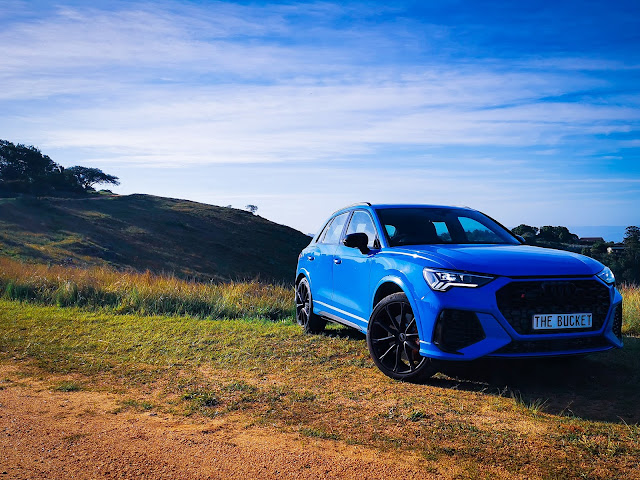
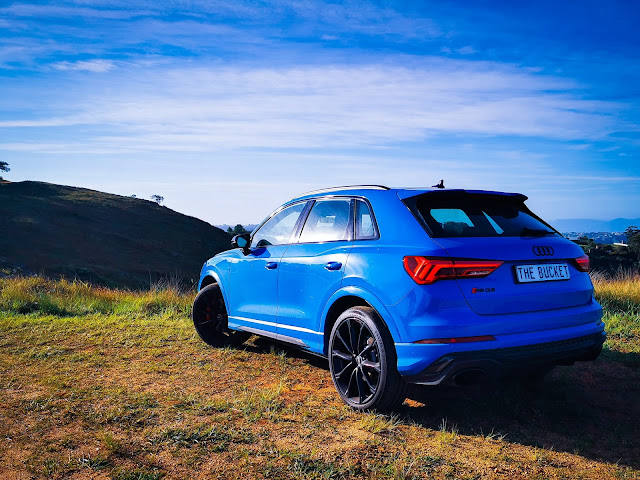
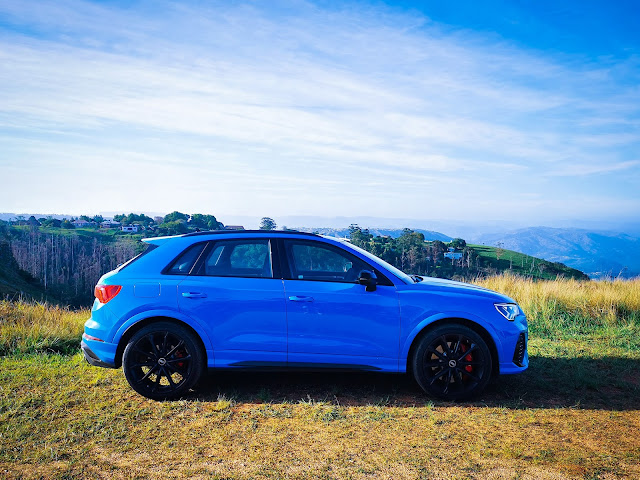
2021 saw Audi launch a wide variety of their performance models locally, something that made people in the motoring fraternity froth at the mouth with the the possibility of sampling all these awesome models. Here in sunny Durban however we aren't spoiled like our counterparts in Cape Town and Johannesburg so we have to take what we get, hence when this car was scheduled for me to test, I got a bit giddy. You see when Audi launch an RS model, you know its special, apart from the immense power it will be housing, it will be loads of fun as well so when the all-new Audi RS Q3 in Turbo Blue, rolled into my driveway, it was only fair for me to give it a fun nickname, hence Sporty Smurf was what I came up with for obvious reasons. Audi launched the RS Q3 in two variants, the standard which I had and the Sportback model which essentially is the same in-terms of performance but has that slanted coupe style roof. Both equally impressive and very attractive, in both looks and pricing for what you get compared to their competition in the market. With this in mind, it was time to see how a car like this performed in real world conditions as well as every day life. 


DESIGN

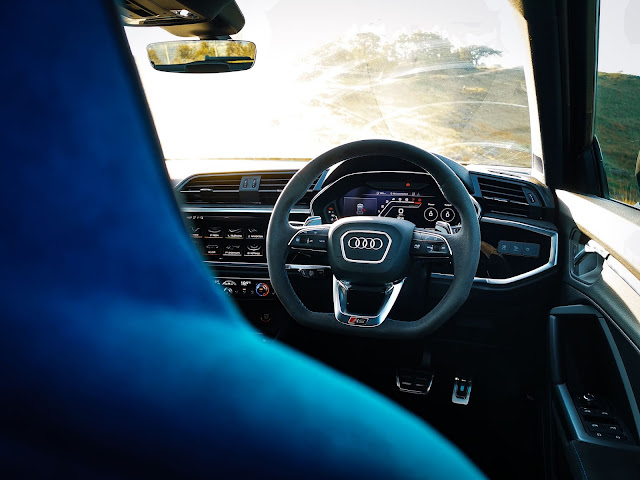
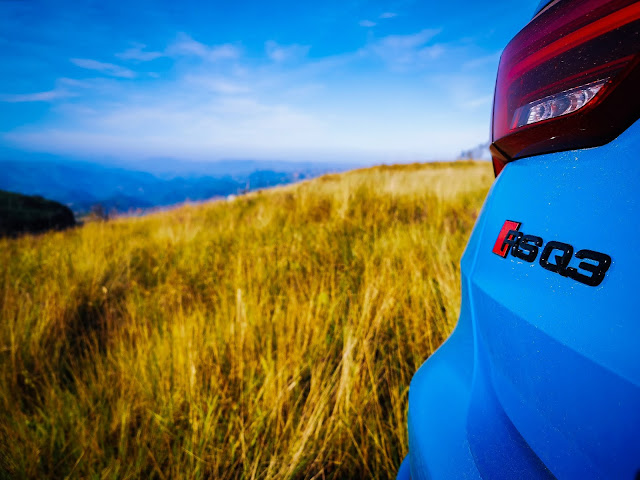
I spoke at length in my review of the Audi Q3 in terms of its new design and how much more better and mature it is to the older model, so taking that and making it more aggressive for the RS model was not a difficult task for the Audi designers. With its lowered stance thanks to an extended front bumper and side sills give the car a more staunch stance, the front bumper has larger air intakes on the sides while the main grille is completely blacked out with a honeycomb pattern, the added front splitter at the bottom gives the front end a great contrast between the dark and the bright. The Audi badges have also been finished off in gloss black, this includes the rings and nameplates, but this is a R5,800 option. Another option extra was the 5V spoke 21-inch rims in black, I must add these blacked out options contrasted beautifully on the bright Turbo Blue metallic paint and may get drowned out on darker colours. The rear diffuser follows the normal RS trend with the highlighted extrusions at the tailpipes which are also finished off in black. While these are dual pipes they are huge, dual tailpipes with plenty of volume. The Audi Q3 matrix LED lights both in the front and the back deserve a mention as they create a stunning look for the car with their design.  The interior has been upgraded to suit the Audi Performance style, with great looking sports seats finished off in leather and alcantara and has a honeycomb stich in blue with the RS logos embossed on the seats. There is a lovely play on materials in the cabin to give the car that sporty look and feel which will be discussed later in the review.
 

PERFORMANCE

Unlike the menacing V8 in RS6 Avant I drove in Cape Town, this RS Q3 features a slightly motor, this one being the 2.5L Twin-Turbo 5-cylinder which is menacing in its own right. The 5-pot delivers 294kW and 480Nm of torque! It is a heck of fun to drive and is rather throaty, couple with the 7-speed S Tronic gearbox with paddle shifts, it makes this heavy SUV feel like a hot hatch. 0-100km/h takes just 4.5 seconds with an electronically limited top speed of 250km/h however this one did come with the option to increase the top speed to 280km/h, not that I could ever achieve that on normal roads. When it comes to average fuel consumption, I don't feel its appropriate to discuss this on high-end performance models like this as it depends purely on driving styles but seeing that the price of fuel has sky rocketed to astronomically figures of late, it is good to note that driving around urban areas in eco mode I did manage to achieve a healthy average of 8.1L per 100km which is pretty decent seeing that I was hitting over 12 for most of my time with it. It has a 60L tank which you can finish in about 350km if you're going pedal to the metal in dynamic mode. Like all of Audi's performance models, the RS Q3 comes with Quattro four-wheel drive so keeping this large SUV planted isn't difficult, the car is rooted to the tarmac and seems at home when navigating the bends. Just to test the SUV nature of the vehicle I took it on some light gravel trails and it faired impressively well even with the 21-inch rims. 


COMFORT
   
I spoke about the sportiness of the cabin as well as the sport seats but while these do have side supports and large head rests, they are super comfy and can be heated as an option. They are fully electric adjustable with memory settings should anyone interfere with your preferred seating style. The cabin came with three-zone climate control which is an extra, usually its just a dual-zone system. Other extras included Audi's phone box package, 360 degree cameras, panoramic glass sunroof and 12V outlet as well as twin USB ports for the rear passengers. The ride quality is faultless, give its on harder suspension and bigger rims, it is still pretty comfy. A reason for this is Audi's adaptive chassis control with Audi drive select that ensures the cars stability and automatically changes to suit its environment. Safety wise, Audi has given its usual list of options which include lane departure warning which has lane change assist and include side assist, it has adaptive cruise control with pre send front collision which warns you if the car in front of you is slowing down. While driving a performance model like this, its quick to forget its actually a practical family SUV with more than enough room for 4 grown adults with a luggage capacity of 530L, so perfect for weekend getaways or long holidays on the road. 


VERDICT

Overall, the Audi RS Q3 takes off from its predecessor as being a practical, affordable performance SUV. It offers all the comfort as the usual Q3 but with the sportiness you'd want from a car like this. While with the increasing price of fuel, if you want a justification into buying a car of this nature, apart from driving it to seeing what you will be getting I feel the RS Q3 offers the perfect balance of practicality of a medium sized family SUV with the same performance you're getting from an Audi TT RS. It's the smallest engine offered in the RS range so you're not going to be taking out loans to fill this one up all the time and while you spend time with it, you get to learn how the car reacts to your driving styles and you will find the sweet spot to give you optimal fuel usage and still enjoy the engine for what it is. 

SPECIFICATIONS

Engine
2.5L 5-cylinder Turbo
Gear Box
7-Speed S Tronic
Torque
480Nm
Power
294kW
Top Speed
250km 
Price
R1,094,000*

*Price test at R1,286,880


Wednesday, November 6, 2019

Bucket Seat: Toyota Hilux GR-Sport


In a bakkie obsessed nation, it was only a matter of time before manufacturers decided to take advantage of this segment by introducing enhanced performance variants to the market. While it still may be relatively new to South Africa, across the globe, especially in the US markets, this has been a much loved segment for over a decade now. Step in Toyota, fresh off celebrating their victory at this years Dakar with South African built Hilux models, it made sense for them to introduce their sporty variant of the Hilux to the country. The Hilux Gazoo Racing Sport first broke cover a few months ago, with Toyota SA later confirming that a limited number of models will be heading to our shores. While the engine still remained the same, there were mechanical upgrades done to the GR-Sport in the form up suspension upgrades, revised dampers and a change in wheels to make this a proper off-road menacing machine. 


DESIGN

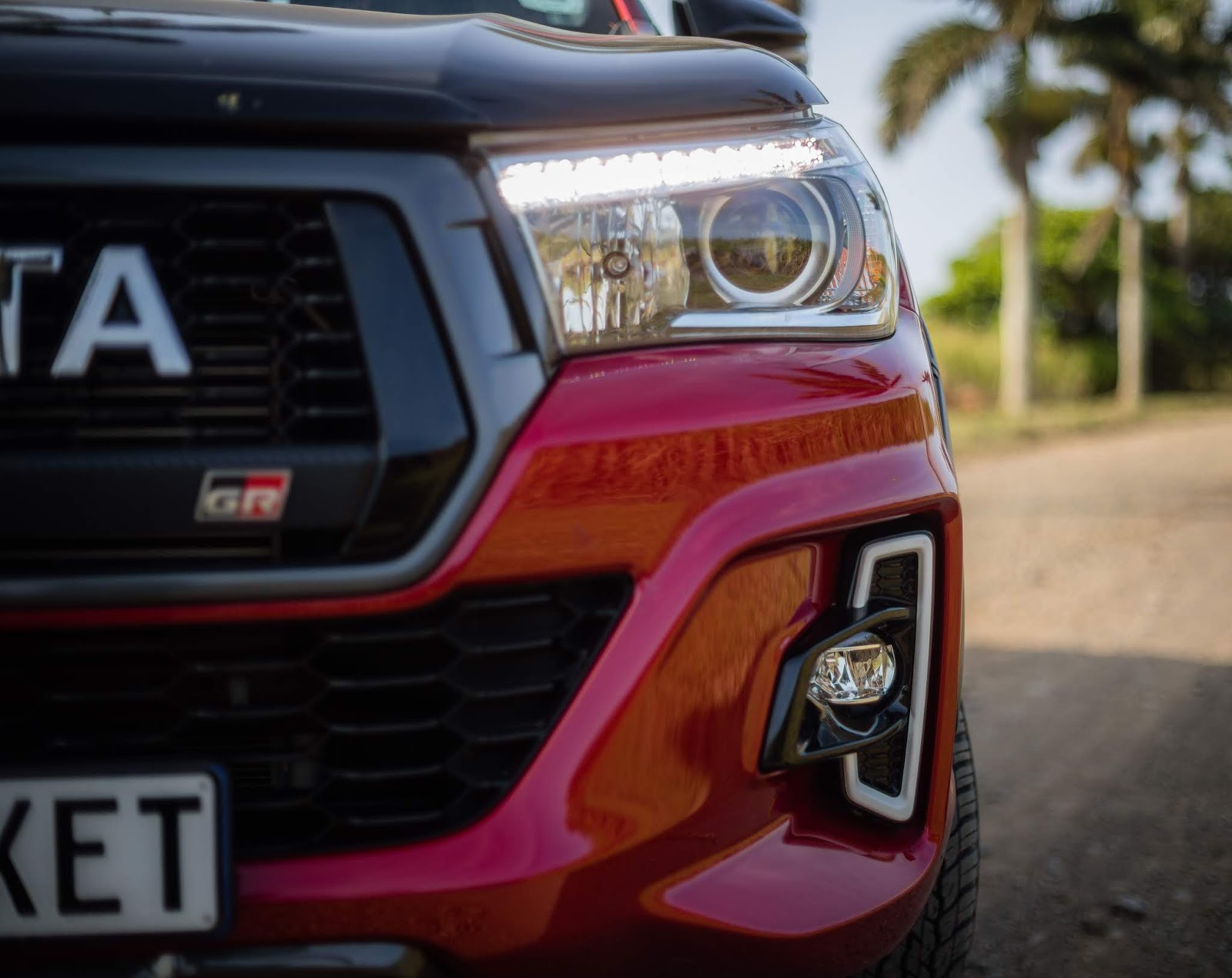
While the overall design of the Hilux GR-Sport is pretty much the same as any other Hilux Double Cab, there are subtle changes to make you aware of this particular model. Those with a keen eye will notice that the Toyota sign on the front grille is spelled out and not just the emblem as on the other models, the bonnet on the GR-Sport is black, there are plenty of GR badges around the car as well as a bigger aluminium side step. The GR Sport also has graphic stickers on the side extending from the front door all way to the bin at the back. The wheels are different to other models as well, with it have blacked out 17" six spoke alloy wheels on all-terrain tyres which have a thicker profile, The car seems to be raised a bit more than normal, could be due to the revised front suspension, giving it that more sportier look. The wheel arches are blacked out and there are hints of carbon on the grille. Moving onto the inside, very much like a normal Hilux but colours and trims that make this one stand out a bit more. The dash made up of a combination of soft and hard touch leathers as well as high gloss finishes in black and red. There's red stitching to the seats and since this being a limited number production unit, a plate with the model number sits just below the gear selector. 


PERFORMANCE

While nothing much has changed under the hood, doesn't mean its not worth mentioning, the GR Sport comes with Toyota's bulletproof 2.8 GD-6 turbo diesel engine which features on popular Hilux models as well the Fortuner range. This engine produces 130kW and 450Nm of torque. While this particular GR Sport model did come with an automatic transmission, the car does have paddle shifts for manual mode. The automatic gearbox does produce 30Nm or torque more than the manual version, this is purely down to the smooth and easy self shifting box. On the road, the GR Sport feels and drives like a normal Hilux, it does feel a bit racy on take off but that could be down to the torque and gearbox. On the dirt, its loads of fun, with it sliding around corners and making dust. This is where you get a real good feel of that revised front suspension setup which consists of a monotube design and revised dampers in action. The GR Sport is a fully fledged 4x4 with all the bells and whistles, it even has a power mode which you can use to up the anti when driving. 


COMFORT

While this may be a bakkie and a performance one, it did feel a hell of a lot more luxurious than other bakkies I've been in. The quality of materials used in the interior are of a high standard, the same as what you'd find in the top of the range Fortuner. Leather dash, high gloss plastic finishes and soft touch leather coverings and steering make the cabin of the GR Sport a very comfortable place to be. The dials of the GR Sport are different to the other Hilux variants, more sportier and finished in white. The large screen infotainment system is easy to use and to sync with your device. The system is compatible with most mobile apps and recently Toyota SA launch an app of their own which is available in the app store of most devices. 


VERDICT

While the price might be a major talking point with the Toyota Hilux GR Sport, it still remains the second most expensive bakkie in the line-up. Also in terms of pricing in its segment, and the exclusivity of the bakkie with only 600 being made, you can see why it is priced that much. The product you getting from Toyota in general is always unquestionably good so this is none the different. Also in terms of the Gazoo Racing models, this is the first model being sold in South Africa, as we were not lucky enough to get any of the GRNM Yaris, but a few months later did get the new Supra. It's a bakkie for the enthusiasts or the thrill seeker, or maybe you just want a collectors edition bakkie, whomever it is, they sure are going to get a great product. 


SPECIFICATIONS

Engine
2.8 Turbo Diesel
Gear Box
6 Speed Automatic 
Torque
450Nm
Power
130kW
Consumption
8.5L/100km
Price
R 714 500


Pictures by @DBN_Spotter